
The Geometry of a Comfortable Ride

Imagine a chair—a standard structure with four legs. Except, this one is so tall that you have to push yourself just to climb up and sit on it. It is made of steel, has no cushion, and features a tiny backrest that does not support the entirety of your back.
Now, imagine another chair. It also has the same standard structure with four legs, but with some key differences. This one matches your height perfectly; you only need to bend your knees, and your bottom meets a lovely, puffy cushion. The backrest is perfect, and it even includes neck support.
Which one would you choose to sit on to watch a three-hour-long film? The latter, of course, unless you want to squirm in your seat throughout the movie.
Even though the basic structures of these two chairs are essentially the same, the key factors that differ in the second chair—the perfect seat height, the lovely cushion, and the backrest—considerably change how we approach them. These little game-changing factors are what make the second chair ergonomic.
What is ergonomics?
Derived from the Greek words ergon (work) and nomoi (natural laws), ergonomics is the science of designing environments, products, and systems to fit the people who use them. Instead of forcing the human body to adapt to a poorly designed object (like stretching to fit into a giant, awkward chair), ergonomics focuses on human capabilities. It studies our limitations and proportions to ensure that tools and spaces support our natural posture and movement.
It’s a concept you already encounter every day. The rubber handle on a steel ladle that protects your hand while you stir a bubbling pot of curry, or the wheels on a heavy suitcase that save your spine from bearing the load, etc., are all examples of ergonomics at play.
A similar philosophy applies to scooter usage. But with changing riding habits, what is the scope for improving its ergonomics? More importantly, how do you make a scooter intended for daily heavy-duty use, ergonomic?
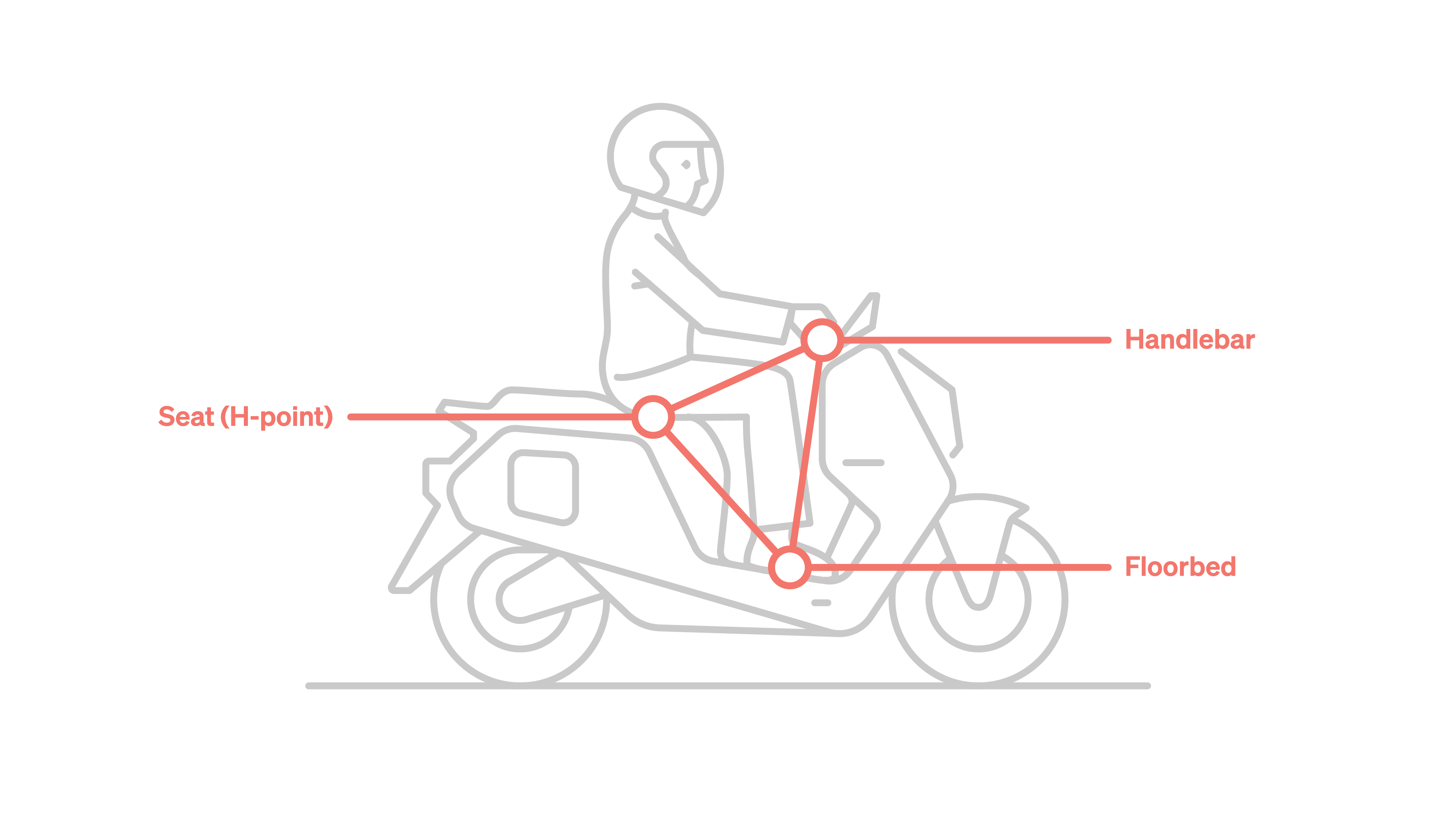
In the world of two-wheelers, ergonomics is defined by the rider's primary points of contact with the scooter. This relationship is determined by a concept known as the ergonomic triangle, or more popularly, the rider’s triangle.
The ergonomic triangle
The ergonomic triangle is the real-life application of basic geometry. The relationship between your seat, your handlebars, and your floorboard forms the ergonomic triangle. While a geometric triangle on paper is static, real-world riding is dynamic. Every single component around the triangle has to be meticulously calibrated to expand, protect, and optimise these three primary points of contact for the scooter to be more flexible and accommodating.
Get this wrong, and you're hunched, strained, and counting down the minutes until you can get off the vehicle. Get it right, and you barely notice you're riding at all. Indie gets it right. The three touchpoints are fine-tuned so your back sits naturally upright, your arms reach the handlebar without stretching, and your feet properly rest without your knees climbing up to your chest.
Here is how the three focus-points of Indie’s ergonomic triangle are tailored to work together.
The seat
The seat is the foundation of the ergonomic triangle, dictating your hip placement and posture. Ride comfort is directly proportional to the quality of your seat; if it is too small, both you and your pillion will quickly grow to resent the journey.
Indie’s seat is long, wide, and exceptionally accommodating. It's padded well enough that you do not even think about it. Whether you're riding solo or with a pillion, there’s space on the seat. Nobody has to perch nervously on the edge, holding on for dear life.
Another key factor on the Indie is the seat placement: the H-point (where your hips sit) is a little farther back compared to most conventional scooters. This design choice is a gamechanger for taller riders. Because you sit further back, your long legs don’t have to fight for space, you don't have to stretch your arms too much, and neither do your knees scrape against the glove box panel when turning the handlebar.
The handlebar
Taking a sharp turn is where a lot of scooters betray you—the handlebar swings around and suddenly your knee and the bar are getting uncomfortably acquainted. When the riding triangle is too small, steering costs you comfort. Indie's handlebar is designed so that even at full lock, there's plenty of clearance between your knees and the bar. Your knees stay unbothered, and you stay focused on the road rather than bracing for that irksome contact.
The floorbed and the front foot-pegs
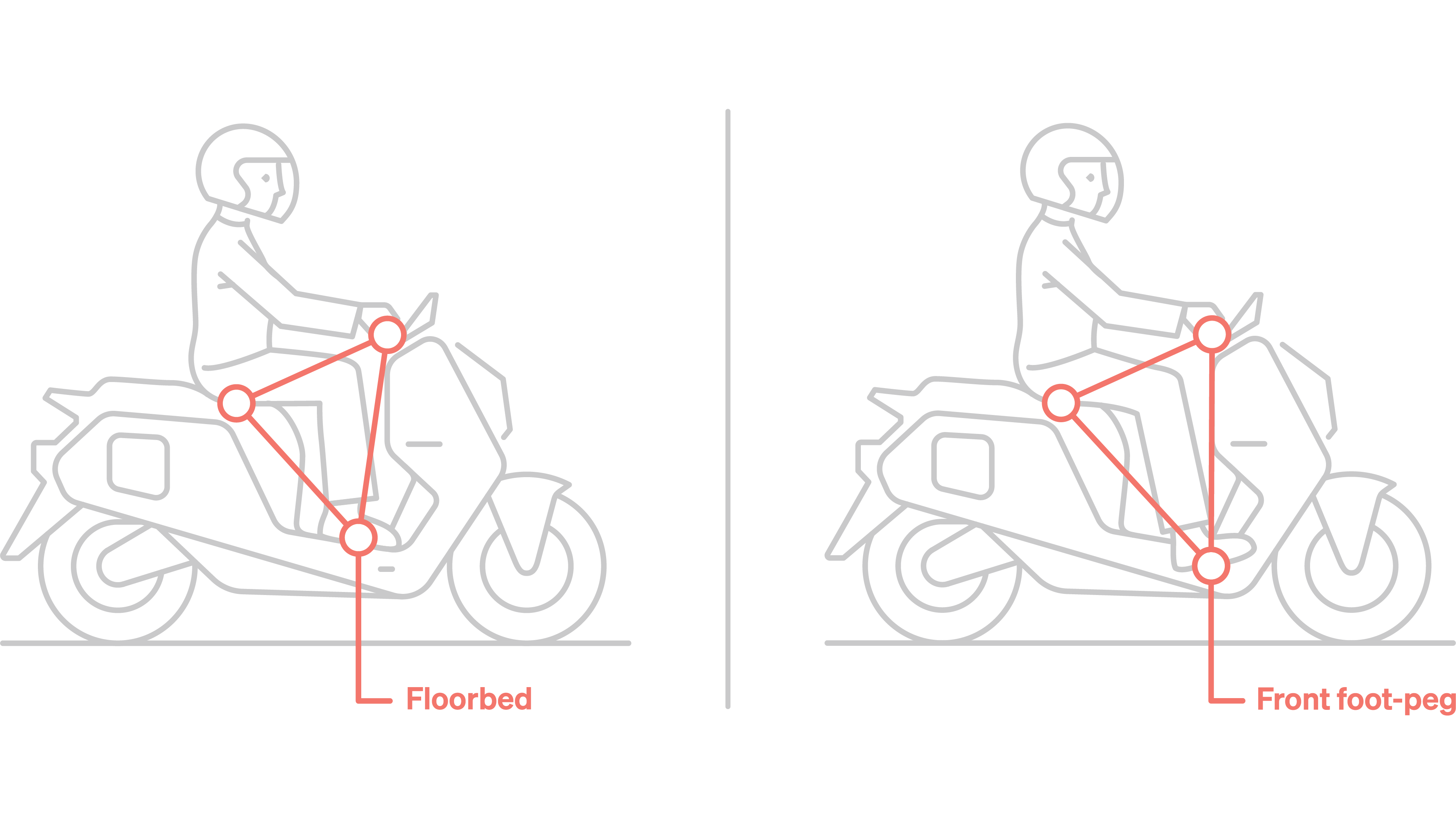
One of the first things you notice when you step onto Indie is how much space there is around your feet. The 20-inch floorbed is generous and gives you the freedom to shift your stance, move your feet, and simply sit as you like.
This space not only directly impacts your comfort, but also is a utility bonus. If the massive floorbed is loaded up with cargo, or if a taller rider simply wants to change their posture, they can throw their feet onto the front foot-pegs.
The front foot-pegs are a hit among Indie users, and anyone who test rides the vehicle. It is the ultimate proof that the ergonomic triangle can be even more flexible. By moving your feet forward, you instantly shift the traditional rider’s triangle into a relaxed, “cruiser-style” riding position. It ensures your knees never feel cramped.
Beyond the triangle
Even though the glove box panel isn’t technically a part of Indie’s rider’s triangle, it drastically influences how you experience it. Finding the perfect riding posture only works if the machine actually accommodates your body's natural movement. On a standard scooter, the glove box sits parallel to your knees. This means every sharp turn or sudden bump risks an uncomfortable collision.
We refused to let a rigid structure dictate your comfort. Instead of a boxy obstacle, Indie’s glove panel is specifically rounded, angled, and set back just enough to create crucial legroom. And we didn't compromise on utility to get there; the glove box still boasts a massive 12 liters of storage.
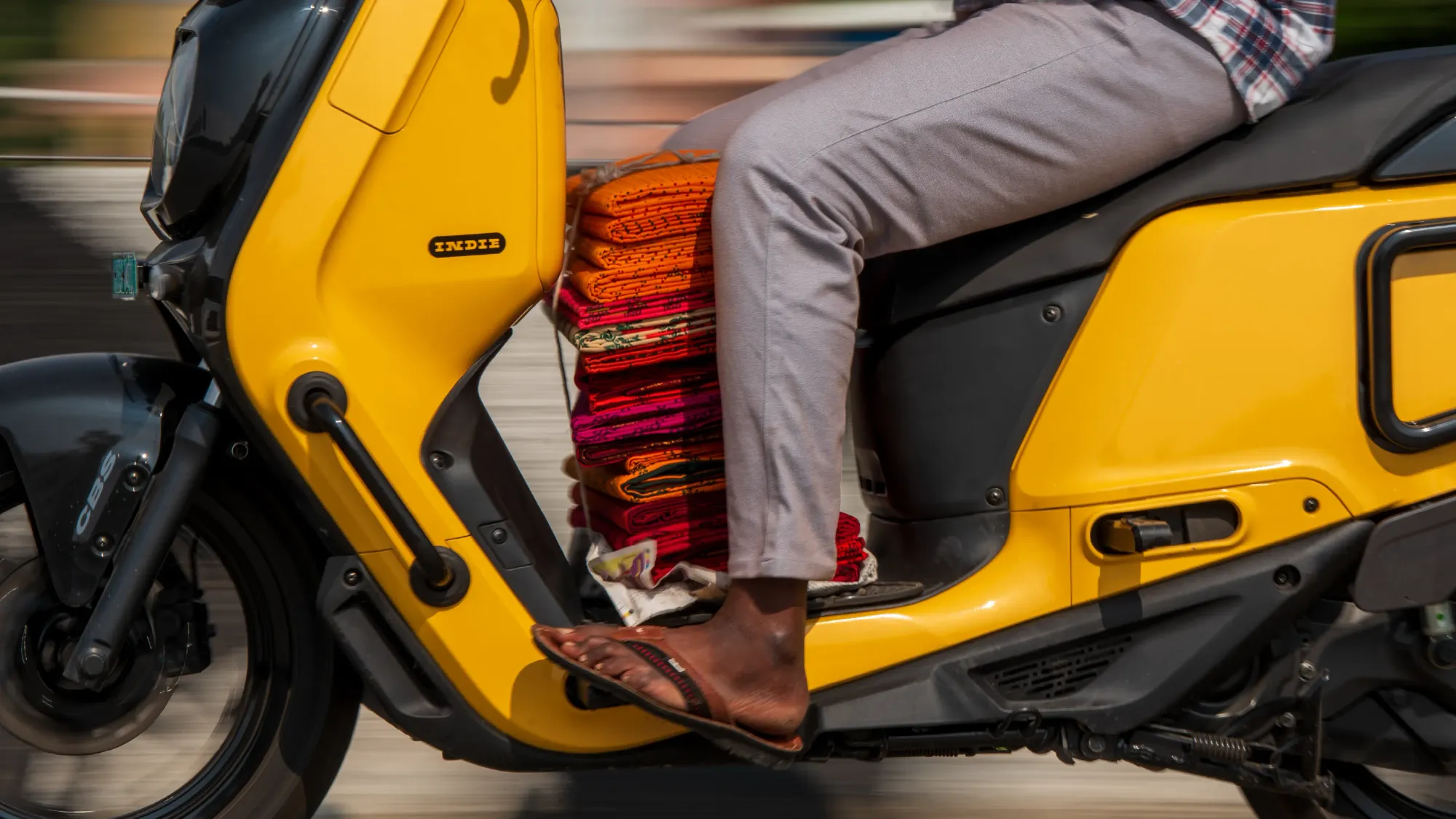
This design choice ensures there is absolutely zero friction if the 20-inch floorbed is fully loaded with cargo, or if you're leaning back using the front foot-pegs. And when you consider the stability-boosting 14-inch wheels, or an optional backrest accessory, every element works in harmony to deliver a flawless riding experience.
For a heavy-duty scooter built to endure the punishing demands of the daily grind, brilliant ergonomics prevent physical fatigue before it even starts. This becomes an invisible problem-solving tool for any rider. By carefully shaping every panel, peg, and touchpoint of the rider’s triangle to natural human geometry, Indie offers effortless support so you can focus entirely on the road ahead. Because at the end of the day, Indie is built for real riders, with real habits, tackling real roads.